
Asian Art Resource Room
Gateway to Modern
and Contemporary Art
Knowing
Majorartists
Choi Jeonghwa
A Spatial Magician Who Makes Mundane Objects Bloom
- Name(Chinese letter)
- 崔正化
- Name
- Choi Jeonghwa
- Media
- Sculpture, Installation
- Region
- South Korea
- Year of Birth
- 1961
- Place of Birth
- Busan, South Korea
- Place of Residence
- Seoul, South Korea
- External Link
- Link to Art Terms
-
- Link to Regions
-
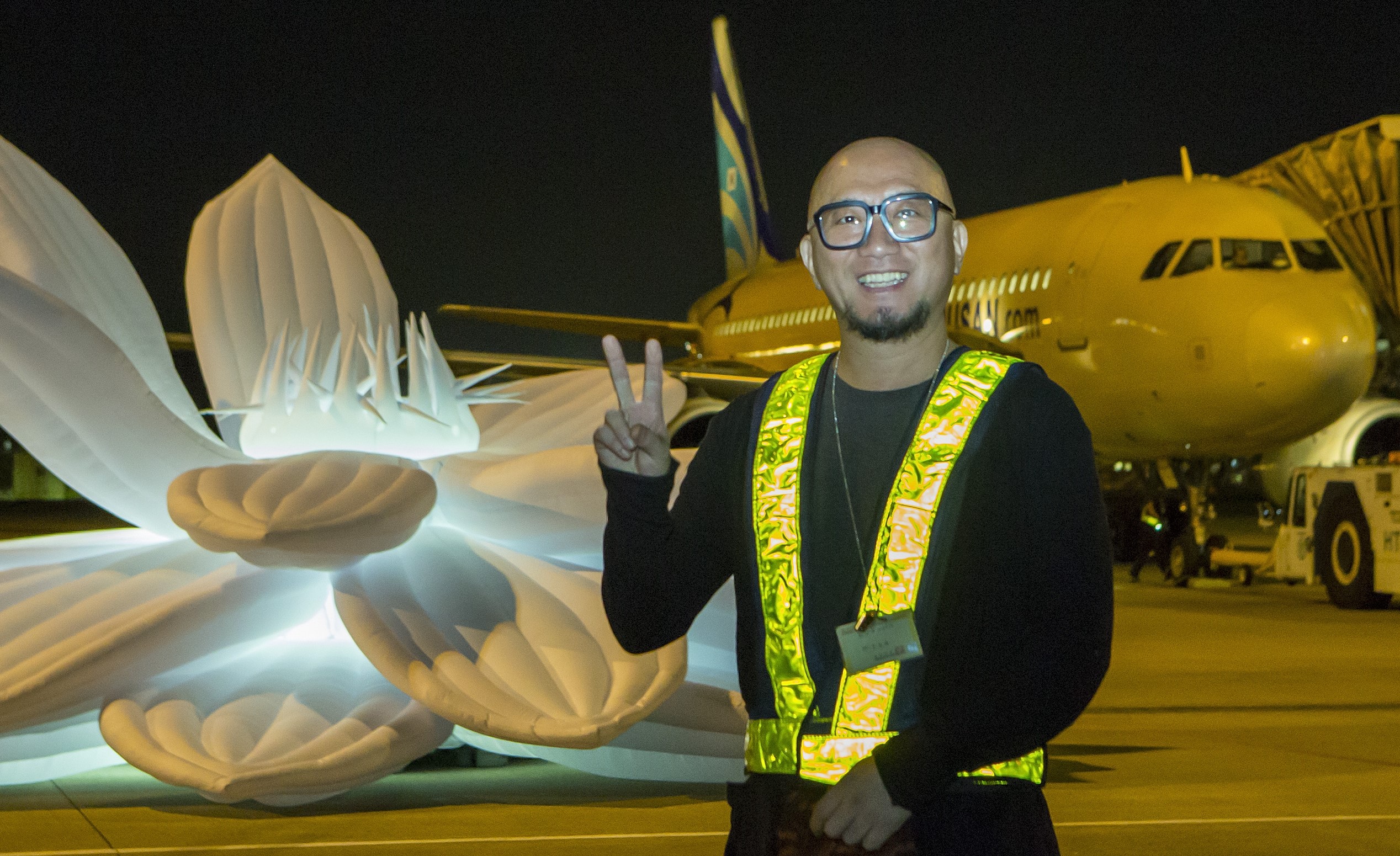
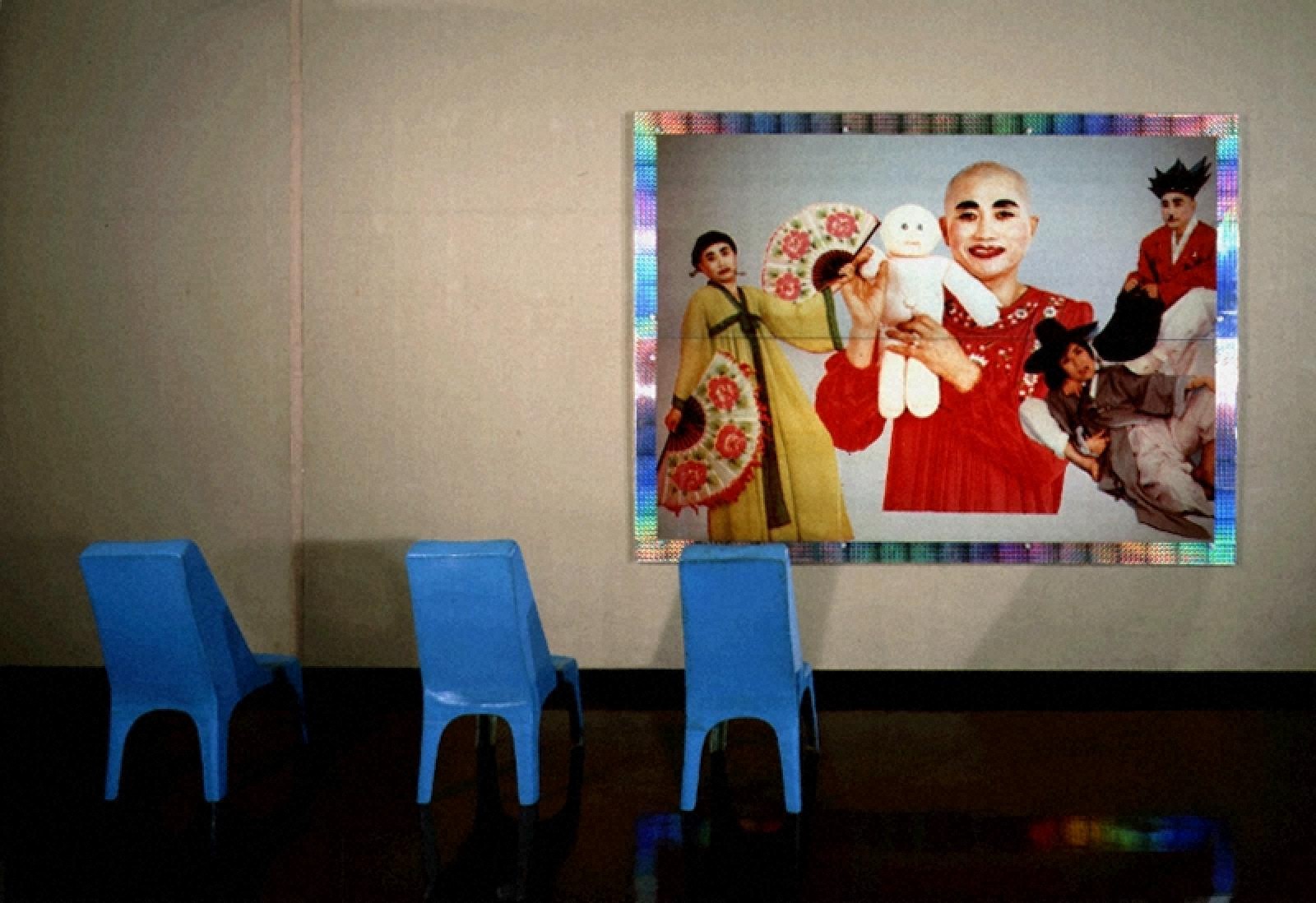
Plate of artwork

A Column is Columns
1998
170 x 170 x 810cm
Festa Square, Hakata Riverain, Fukuoka
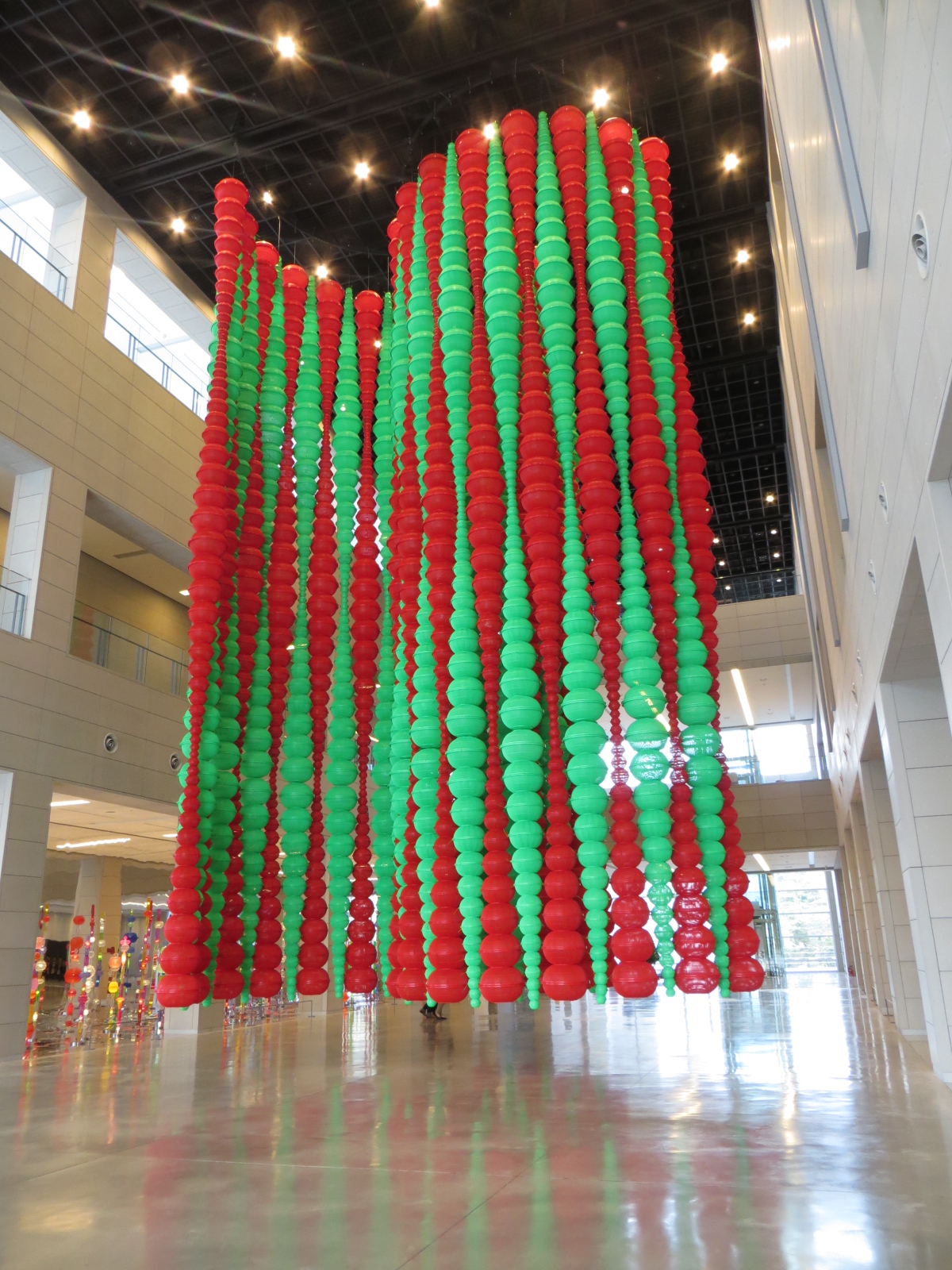
Kabbala
2013
Solo exhibition at Daegu Art Museum
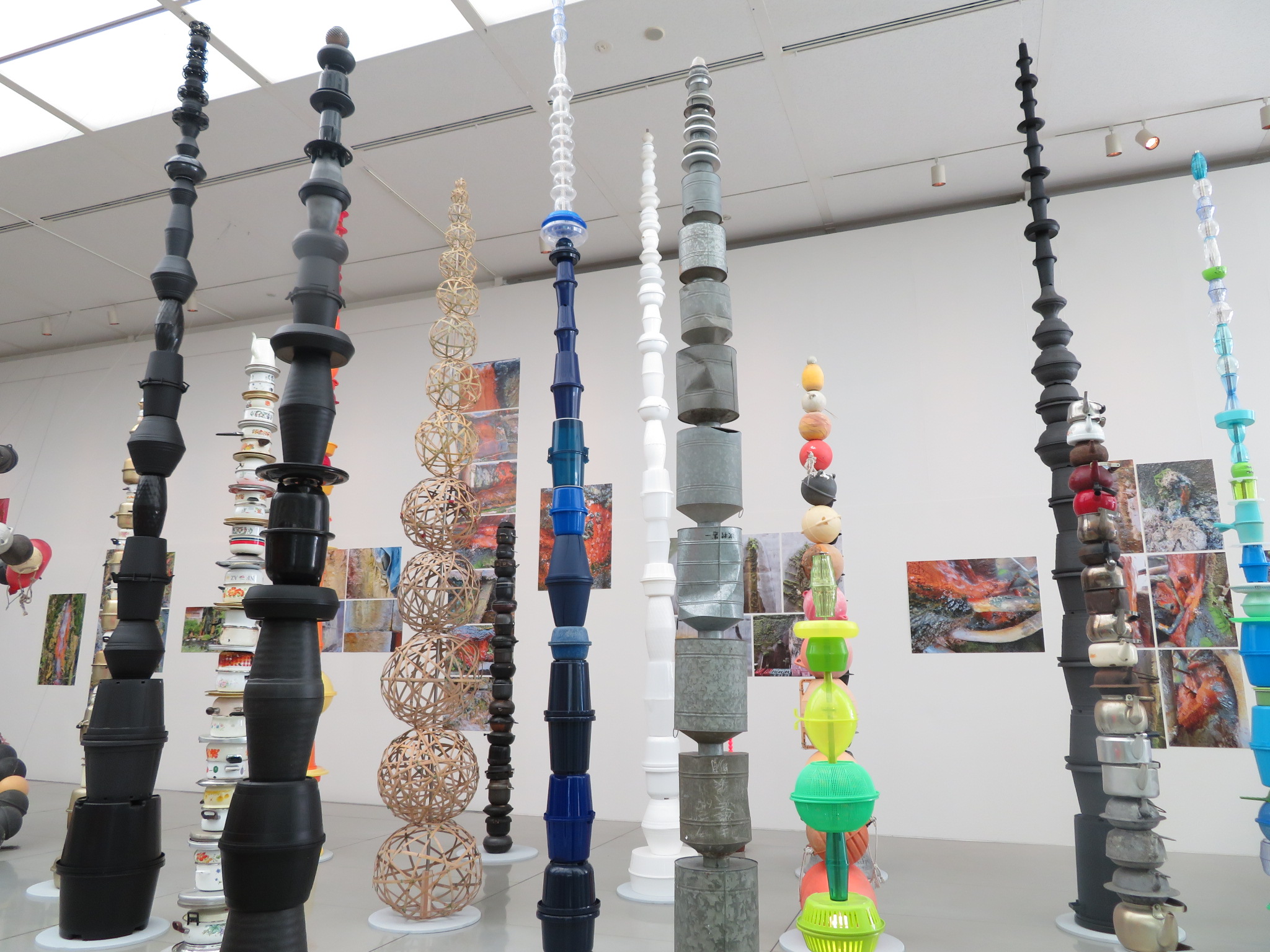
Solo exhibition at Kirishima Open-air Museum, 2022

Breathing Flower
with an Air Busan plane at Fukuoka Airport
The 5th Fukuoka Triennale, 2014.
The Secret of His Success
Choi Jeonghwa is a leading figure of the New Generation movement that emerged in South Korea in the late 1980s, and he remains active today in an extraordinary number of exhibitions and art festivals around the world.[1]
Choi works with “non-art” materials and methods drawn from everyday life in Korea, using items such as the plastic colanders and kitchenware long found in most households, as well as ordinary daily objects with no value as antiques. He amasses these materials in large quantities and arranges them in installations. He also produces giant inflatable flowers and vegetables reminiscent of those used in urban advertising and displays, along with outdoor sculptures covered in brightly colored flowers. The humor and appeal of these materials, combined with their strong visual and spatial presence, elicits surprise and delight from viewers who may have little familiarity with contemporary art, including children. His works also attract audiences who have grown weary of international exhibitions filled with pieces that require extensive explanations or great patience to understand, and this broad appeal has cemented his worldwide popularity.
Many Korean artists who became active internationally from the 2000s onward studied in Europe or the United States. Choi is unusual in that he graduated from Hongik University’s College of Fine Arts, one of Seoul’s leading art schools, but never studied abroad. From early on, he chose not to define himself strictly as an artist, instead working as a designer or producer with the aim of engaging wide audiences, and he has a proven track record in that role. However, viewing his work as merely crowd-pleasing or anti-intellectual risks missing the fact that Choi introduced strikingly innovative ideas within the Korean, and indeed Asian, art scene, and that his thinking, while rooted in Korean culture, resonates internationally. His remark that “Art is like the fur of a turtle or the horns of a rabbit”[2] paraphrases Huineng’s Platform Sutra, a foundational Zen Buddhist text, and shows how the ostensible accessibility of his work reflects his broad knowledge of religion and philosophy.[3]
“Art Like Interior Design, Interior Design Like Art”[4]
Choi, who studied Western-style painting at Hongik University, received early recognition by winning the Second Prize and then the Grand Prize in consecutive years at the newspaper JoongAng Ilbo’s open-call JoongAng Fine Arts Exhibition in 1987 and 1988. However, as if severing his connection to art, he burned his earlier paintings, including the award-winning works. After graduation, he began reaching audiences far beyond the art world through spatial design for the fashion brand Ssamzie, graphic design for magazines and other publications,[5] and direction for theater and dance. From 1989 onward, he undertook this work not under his own name but as Ghaseum[6] Studio, reflecting his choice to reach the wider public through collaborative production rather than through individual artistic practice.[7]
Before long, Choi returned to fine art, and through his work in production, planning, and spatial design he helped spark major shifts in Korean art. He not only designed cultural spaces such as OLLO OLLO (a bar next to Ewha Womans University, 1990), OZONE (a club and bar in Jongno 2-ga, 1991), SAL (a café in Daehangno, 1996 to 1997), and Ghaseum (a café, bar, and gallery in Nagwon-dong, 2008 to the present), but also organized events including parties and performances. In doing so, he created platforms for presentation and exchange among progressive cultural figures of the time, not only in art but also in dance and theater, including Lee Bul and Lee Sookyung (now Yeesookyung), who would later become well known.[8]
Among exhibitions that Choi organized, group shows such as Sunday Seoul (1990) and Made in Korea (1991)[9] announced the arrival of the New Generation. Within the broader current that is said to have begun with the exhibition Museum (Kwanhoon Gallery, 1987), this opened a completely new path in Korean art, distinct both from the monochromatic Dansaekhwa painting associated with Park Seobo and others that had dominated since the late 1970s and from Minjung Misul (People’s Art), which continued to exert strong influence even after democratization in 1987. Its defining characteristic was the reuse of materials and images drawn from mundane, mass-oriented urban culture, typified by Choi’s work.[10] It heralded the advent of Korean postmodernism in its refusal of a “grand narrative,” unlike the traditional aesthetic orientation that underpinned the modernism of Dansaekhwa or the daily-life concerns and pro-democratization activism associated with Minjung Misul. Instead, it employed non-artistic kitsch objects without hesitation, even at the risk of appearing thoughtless, frivolous, or ephemeral.[11] Choi had a clearly evident gift for constructing spaces (i.e. installations) from everyday goods found in ordinary Korean markets and from discarded materials on the street,[12] and this approach would later expand into large-scale works.
After his introduction at the Fukuoka Art Museum’s 4th Asian Art Show in 1994, Choi’s works made a strong impact on Japanese curators and audiences who were already relatively familiar with Korean contemporary art. He was frequently invited to show work in curated exhibitions at Japanese museums and other venues from then on. He went on to take part in an extraordinary number of exhibitions worldwide, and within Korea he held his first solo museum exhibition in 2013 at the Daegu Art Museum. He made full use of the museum’s expansive spaces, and the large-scale work installed in the atrium, measuring 18 meters in height and 10 meters in width and made from red and green colanders, was particularly astonishing. In 2018, he was invited to hold the fifth edition of the major solo exhibition series at the National Museum of Modern and Contemporary Art (Seoul),[13] firmly establishing his reputation as one of Korea’s leading artists.
Expansion and Concentration
Choi Jeonghwa feels a sense of fear toward actual nature, such as plants that have dwindled in number in Korea, but he takes pleasure in artificial objects that do not decompose.[14] For him, plastic is “secondary nature” rather than fully “artificial,” as the people who produce it are themselves part of nature.[15] At the same time, plastic products that now appear unmistakably cheap were symbols of the industrialization that enriched Korea in the 1970s and 1980s.[16] The objects Choi selects, even if dismissed by art enthusiasts, are imbued with the dreams, fantasies, and desires of ordinary Koreans who sought value in the form of beauty, food, victory, abundance, or convenience.
Unlike art objects such as oil paintings, which are expensive and require strict control of temperature, humidity, ultraviolet light, and other conditions, Choi’s works comprise inexpensive or even valueless everyday items made from plastic, a material that can withstand severe natural conditions. This allows his installations to unfold in urban settings, including outdoor sites beyond museums, by taking full advantage of sheer quantity. An exhibition at a stadium in Seoul employed 1.7 million discarded objects. At the Towada Art Center, he showed works in 14 sites across the city, including inside the museum as well as at the fish market and in local shops.[17] He demonstrated the same capacity to fill entire spaces through sheer volume at his solo exhibitions at Culture Station Seoul 284[18] in 2014 and at the Kirishima Open-Air Museum in 2022.[19] Most of these installations are on view only for the duration of each exhibition, although some permanent public works can be seen in Japan.[20]
These materials are not only gathered by the artist himself but are also often collected from the general public when he calls for specific items. At the solo exhibition noted above at the National Museum of Modern and Contemporary Art, 7,000 unwanted metal tableware pieces were assembled to form the nine-meter-tall sculpture Dandelion.
Alongside these large-scale outdoor works, Choi has in recent years produced a substantial body of works in the series Blooming Matrix, which succinctly conveys his ability to turn ordinary, low-value objects into art through a deceptively simple structure. Each piece consists of vertically stacked objects of a single type, arranged either by size or with other variations applied. The materials include plastic buoys, wooden boxes, pots, kettles and other kitchen utensils, colorful light fixtures, traditional pillows and tables, washboards, and items whose original uses are no longer clear.[21] At times they are infused with a sense of everyday life, at others a touch of glamour, humor, or a feeling of religious awe. Their diversity seems inexhaustible, and as a whole they reveal the magic of the world we move through each day. Many incorporate elements of Korean traditional craft and religious custom, but the adaptability of this approach across cultures has been demonstrated by works made from locally sourced materials at the Kirishima Open-Air Museum and other sites.
As with Breathing Flower, installed for only a few hours at Fukuoka Airport during the 5th Fukuoka Asian Art Triennale (2014), which asserted a presence on the scale of an aircraft, the sheer volume and visual force of Choi’s works align naturally with the spectacle-oriented demands of contemporary art festivals. At the same time, Choi’s anti-art deployment of materials with close to zero commodity value is an undisguised provocation to the elitist tastes of art lovers. What ideas lie behind this approach?
A Diverse, Egalitarian, and Harmonious World
Interviews with Choi reveal that he is not merely a product of contemporary urban culture who plays around with kitsch materials, but a highly cultivated individual with a strong interest in traditional culture such as calligraphy, jogakbo quilting, and Buddhism. His father was the secretary to Cheongdam, a prominent monk in the Jogye Order, the most influential Buddhist sect in Korea, and from a young age, Choi had contact with high-ranking monks at temples across the country. His frequent use of plastic, a material that does not decay, may be linked to the Buddhist concept of the cycle of birth, death, and rebirth (samsara).[22] However, this tendency seems more broadly connected to the religious phenomenon of fetishism, found worldwide, rather than being solely a Buddhist concern.
Choi focuses on what has been overlooked in contemporary cities: the things that exist beside, next to, and in between. This is not simply an approach to gathering materials, nor is it an attempt to mock popular kitsch from a condescending perspective. Rather, it reflects a philosophy rooted in trust in humanity, as described in the following quote, and presents a bold challenge to the polarization, chaos, and inequality that pervade modern society.
For the artist who works with all ages and countries, everything in the world, especially the sides and the back of it that others have not taken much interest, the marks and traces of common life, shall be the beings that exist on the side and beside. Such concepts of side and beside is also the logic of neighbors and relations. It is the relations where different people, humans and humans/artificial objects, humans and nature, objects and nature, nature and nature, and even heterogeneous times and spaces are equally neighboring with each other, ultimately leading everything in the world is equal and in harmony. (Min Byung Jic)[23]
(Kuroda Raiji, translated by Christopher Stephens)
[1] In 2016 alone, Choi carried out 14 exhibitions and projects in South Korea, Japan, Taiwan, France, Finland, and the United States.
[2] FT5 (5th Fukuoka Asian Art Triennale 2014) Visual Guidebook, Fukuoka Asian Art Museum, 2014, 49.
[3] Choi’s strong recommendation that David Elliott read Jared Diamond’s Guns, Germs, and Steel hints at the breadth of Choi’s reading. David Elliot, “Choi Jeong Hwa: Gangnam Style,” Kabbala: Choi Jeong Hwa (Daegu: Daegu Art Museum, 2013), 20.
[4] Interview by Yoon Jeewon, “No One, Choi Jeong Hwa,” Kabbala, 41–42.
[5] Magazines for which Choi did design work include the fashion magazine Ssammzie Book, the literary magazine Munhak Jeongsin, and the dance magazine Mom.
[6] The Korean word ghaseum means heart or chest.
[7] Choi later also served as an art director for films. These include 301, 302 (dir. Park Chulsoo, 1995), collection of the Fukuoka City Public Library; Bad Movie (dir. Jang Sunwoo, 1997), and Sympathy for Mr. Vengeance (dir. Park Chanwook, 2002).
[8] At OZONE in 1992, a two-person exhibition was held by Nakamura Masato (then studying at Hongik University) and Murakami Takashi, which traveled to Tokyo and Osaka the following year. This exhibition, titled with the artists’ surnames (which happened to be the two Japanese names most reviled in Korea during the Japanese colonial period), featured Nakamura (who would later leave a major mark on contemporary Japanese art as the nation’s representative at the Venice Biennale, as director of various art festivals, and as operator of Arts Chiyoda 3331, a large cultural venue in central Tokyo) and Murakami, who would become one of the most internationally acclaimed Japanese artists.
[9] A work of the same name is in the collection of the Fukuoka Asian Art Museum.
[10] Choi was greatly influenced by the fashion, design, and manga he encountered during a trip to Japan in 1985, and by objects he found on the streets of Bangkok, Thailand, in 1990.
[11] Yoon Jinseub, “New Generation Art: Rebellious Imaginations,” Monthly Art no. 3806 (August 1994), 149–160.
[12] “My installations are applications of what I learned not in university but in the market.” Interview by Yoon Jeewon, 44–45.
[13] In this solo exhibition series sponsored by Hyundai Motor Company, exhibitors prior to Choi were Lee Bul, Ahn Kyuchul, Kimsooja, and Lim Heung-soon.
[14] Elliot, 16.
[15] Toyama Aruma, (Towada Art Center), interview with Choi Jeonghwa (October 19, 2023) [Japanese onluy]
[16] Woo Jung-ah, “A Flower of CHOIJEONGHWA: The Future of Sublime Labor,” Hyundai Motor Series 2018, Choi Jeong Hwa: Blooming Matrix, National Museum of Modern and Contemporary Art, 2019, 454.
[17] According to the catalogue for Choi Jeonghwa: OK!, First Anniversary Exhibition (Towada Art Center, 2009).
[18] The Choi Jeong hwa: Natural Color, Multiple Flower Show, Cultural Station Seoul 284, 2014.
[19] 20th Anniversary Special Exhibit Choi Jeong Hwa, “Sei Sei Katsu Katsu” Life, Live All That Shining
[20] Works by Choi on permanent view in Japan include:
Columns are Columns (1998), Hakata Riverain (Fukuoka), ; Fruit Tree (2001), Rinko Park (Yokohama); Roboroborobo (2003), Sakurazaka Park, Roppongi Hills (Tokyo); and Flower Horse (2008), Towada Art Center (Aomori).
[21] Choi’s 2016 solo exhibition at the National Museum of Modern and Contemporary Art featured 150 works. See Choi Jeonghwa: Blooming Matrix.
[22] Elliott interprets Choi’s words. Elliott, 17.
[23] Min Byung Jic, “Choi Jeong Hwa: Origin, Originality,” Choi Jeong Hwa: Origin, Originality, Choi Jeong Hwa et al. (ed.) (Seoul: P21, 2018), 558.